Lately, we have all been feeling the same pressure: making a living is getting harder, marketplace prices keep skyrocketing, yet our wages and income remain completely stagnant. On the news, officials constantly assure us that "our economy is safe and strong." Curiously, however, our currency continues to take a beating, and all around us, more and more neighbors and relatives are facing sudden layoffs.
In a candid and honest discussion on the YouTube channel Abraham Samad SPEAK UP, senior economic analyst Yanwar Rizki unmasked what is truly happening to our nation. It turns out that our country's "glamorous lifestyle" has not been built on the sweat of our own local factories, but rather by continuously borrowing money and accumulating massive foreign debt.
As ordinary citizens who feel the harsh realities of surviving at the grassroots level, we can no longer afford to sit idly by and rely on empty promises from above. We must understand the underlying disease and start taking our own independent action!
Why does cash flow in society feel so "dry" right now? The explanation is actually quite simple, mirroring exactly how we manage a household budget:
Our government is currently living far beyond its means. Tax revenues from the public are declining as purchasing power weakens, yet government expenditures continue to be lavish and unchecked. As a result, our national reserve savings have hit their lowest point in history.
To keep the political atmosphere calm, a vast portion of the state budget is funneled into mega-projects designed to please political elites and specific interest groups. Programs claimed to reach rural areas often end up benefiting only a handful of contractors or local rulers, failing to revitalize small local shops or grassroots community businesses.
Many small and medium enterprises (SMEs) are suffering because their tax refunds (restitutions) are being held back by the state treasury. Yet, for local business owners, that money is critical to rotate capital and pay worker salaries. When this cash flow is gridlocked, companies are forced to lay off staff, leaving virtually no money circulating among ordinary citizens.
During the discussion, a compelling analogy was shared: You cannot solve a problem by continuously blowing into a balloon, because sooner or later, that balloon is bound to burst.
Every time our nation runs short on funds to finance its grand programs, the shortcut taken is always the same: securing new foreign debt. Today, the maturing debt that must be repaid has broken through hundreds of trillions of Rupiah. Worse yet, international lenders are beginning to doubt and lose faith in our actual capacity to pay them back.
This brings to mind the historic words of Bung Karno: "Our struggle after independence will be harder because we will be fighting against our own people." How can this nation ever break free from modern debt-colonization if our leaders still think, "It doesn't matter if the debt piles up, as long as my circle gets a piece of the project cake right now"?
The only way to prevent this "debt balloon" from popping and destroying the lives of ordinary citizens is a strict Budget Diet. The government must have the courage to halt non-urgent, luxury projects and pivot entirely toward protecting the wallets of the working class.
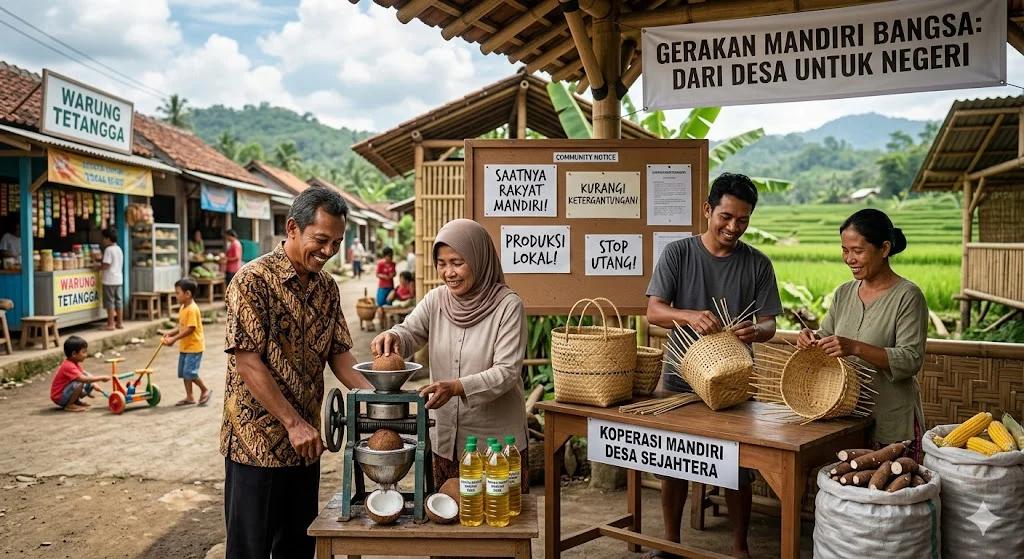
So, what can we do as citizens? We cannot keep relying on imported goods or the mercy of central budget allocations. We must spark a National Self-Reliance Movement from the ground up through genuine decentralization—redistributing production hubs directly to the regions:
For a long time, many of us have survived by operating small retail shops or selling on digital marketplaces. But do we realize that most of the goods we sell are cheap imports from China? The moment their economy encounters a hiccup, supply chains freeze, and we are left with nothing to sell. We must start learning how to manufacture and produce our own goods right in our hometowns.
The village funds distributed from the center should not be wasted entirely on paving empty roads or building vacant warehouses. Communities must unite to demand that these budgets serve as collective business capital through local cooperatives. True cooperatives take our own local produce—like cassava, rice, milk, or agriculture—and process them into finished goods with high market value.
To keep our hard-earned money from escaping to major cities or overseas, we must strengthen cash circulation within our own communities. Shop at your neighbor's small store, buy your rice directly from local farmers, and employ the services of people living right around you.
Economic crises never truly touch the ultra-wealthy who hold safe reserves of Dollars or gold in their banks. A crisis always strikes us—the lower-middle class—who live off daily or weekly wages.
It is time to stop waiting for a miracle from above. Let us close ranks at the neighborhood, community, and village levels. Let us prove that regular citizens hold immense power when they unite and work together. It is time to eliminate dependency, produce what we need ourselves, and establish true national self-reliance on our own soil!

