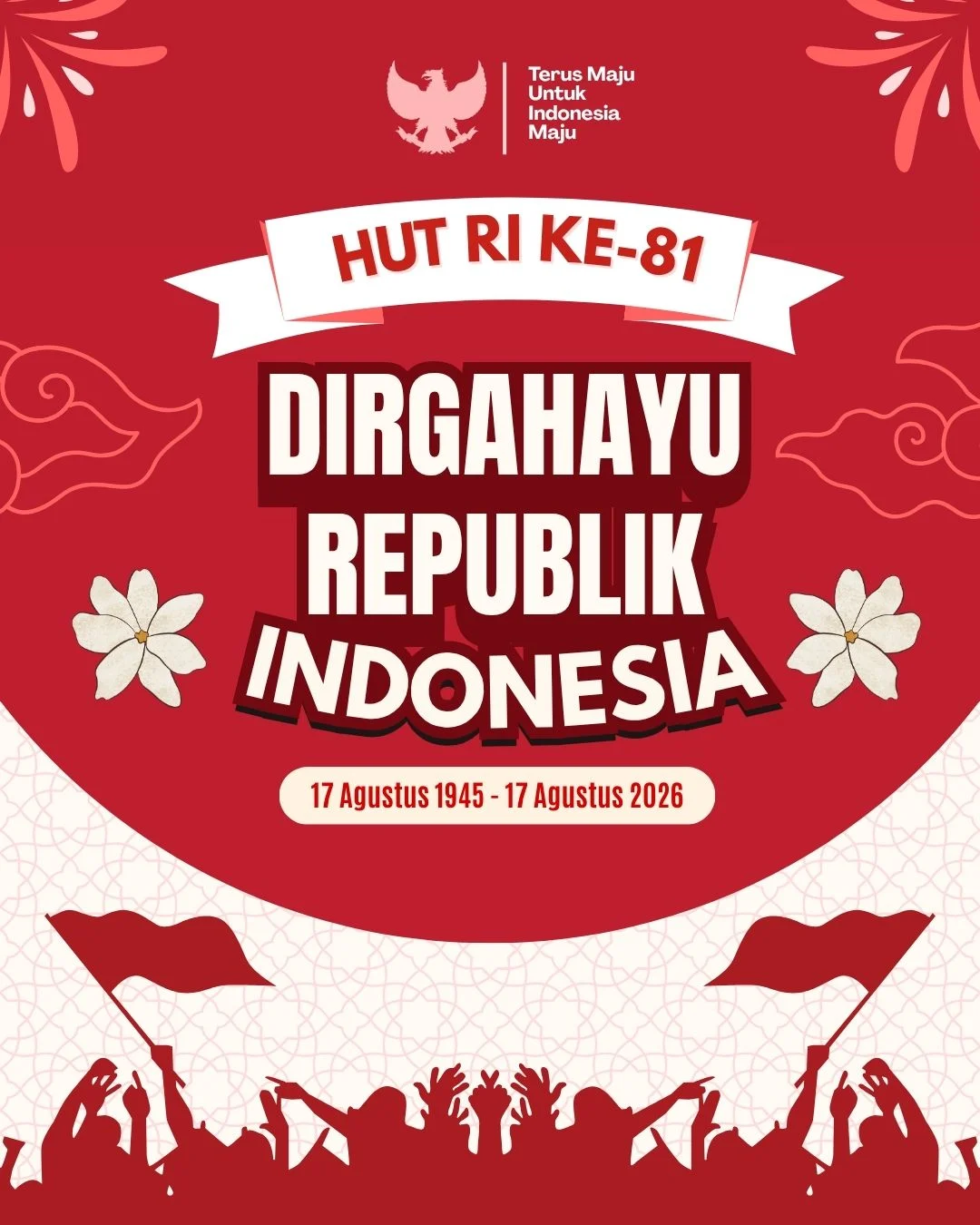
Tomorrow, Monday, August 17, 2026, Indonesia will mark the 81st anniversary of its independence.
The Red and White flag will once again fly proudly over homes, offices, schools, villages, cities, and public spaces across the country. The national anthem will be sung. Ceremonies will be held. Children will take part in traditional games. Messages of Happy Independence Day will fill our conversations and social media.
All of this matters.
But after the ceremonies are over and the flags are lowered, there is a far more important question we should ask: What does independence mean for the people of Indonesia today?
Independence is not merely freedom from colonial rule.
It also means having the opportunity to shape our own future. It means that people's voices are heard, that regions have the space to develop according to their own potential, and that every citizen has a fair opportunity to live with dignity.
Eighty-one years after the Proclamation of Independence, Indonesia's challenges are naturally different from those faced by the nation's founders.
In the past, the central struggle was to achieve and defend independence. Today, the challenge is to ensure that independence is genuinely experienced in people's everyday lives.
Amid rapid technological change, global economic competition, regional inequality, changing patterns of employment, environmental challenges, pressures on democracy, and growing public expectations for quality public services, Indonesia needs a new way of thinking about development.
We cannot continue building Indonesia in exactly the same way when the challenges themselves have changed.
Independence Must Not Stop at the Center
Indonesia is far too large to be treated as if it has only one face.
There are villages whose economies depend on agriculture. There are communities whose lives are tied to the sea. There are regions rich in natural resources. There are cities growing through industry and services. There are areas with enormous tourism potential. There are also regions that require greater support because of geographical and infrastructure limitations.
Each has its own challenges, strengths, and needs.
Therefore, good development should not be about making every region look the same. It should be about giving every region the opportunity to grow according to its own strengths and character.
This is where decentralization should find its deeper meaning.
Decentralization is not simply about transferring administrative responsibilities from the central government to local governments. It should be a way of bringing decisions closer to the people who understand the realities of their communities best.
Indonesia needs to move from instruction to initiative.
From dependency to self-reliance.
From waiting for assistance to creating solutions.
And most importantly, from treating people as objects of development to making them subjects of development.
Indonesia Does Not Lack Potential. We Lack Space to Mobilize It
Too often, we speak about Indonesia as if the country's future is determined only by what happens in Jakarta.
But Indonesia actually moves through thousands of villages, districts, cities, communities, campuses, markets, farming areas, fishing communities, small businesses, young people, women, creative workers, and civil society groups.
That is where the real life of Indonesia takes place.
If we want to build a stronger Indonesia, we must have the courage to recognize this strength from the bottom up.
We must ask:
These questions are more important than simply asking how many government programs can be launched.
Ultimately, the success of development should not be measured by the number of programs announced, but by how deeply people's lives actually improve.
Democracy Must Be More Than Once Every Five Years
Independence is also inseparable from democracy.
Democracy must not stop at elections, voting, or the peaceful transfer of political power.
Democracy must exist in everyday life.
People must have space to express their views. Citizens must be able to monitor public policies. Governments must remain open to criticism. And communities must have meaningful opportunities to participate in decisions affecting their own future.
We do not need citizens who are only invited when their votes are needed.
We need citizens who remain involved after elections are over.
Public participation must become a habit of democracy, not merely a political slogan.
A strong government is not one that fears criticism. A strong government is one that can listen, correct itself, and improve its policies based on realities on the ground.
Economic Independence Begins with Empowered Communities
There can be no complete independence without economic independence.
A nation may be politically independent, but if significant numbers of its people still lack adequate access to education, employment, capital, technology, healthcare, and economic opportunity, then an important part of the independence project remains unfinished.
Therefore, today's independence agenda must be about empowering people.
- Farmers need stronger bargaining positions.
- Fishermen need fair access to markets.
- Micro, small, and medium-sized enterprises must have opportunities to grow.
- Young people in the regions must have equal opportunities to learn, innovate, create, and build businesses.
- Women must have equal space to contribute.
- Villages must not be viewed merely as recipients of government programs, but as potential centers of economic, social, and cultural growth.
Self-reliance does not mean walking alone.
True self-reliance means having the capacity to stand on one's own strength while still being able to cooperate with others on equal terms.
Gotong Royong for a More Mature Indonesia
At 81, Indonesia does not need more slogans.
Indonesia needs more people willing to work.
They do not have to be government officials. They do not have to stand on a stage. They do not have to hold positions of power.
A teacher who educates with dedication is contributing to independence.
A farmer who helps secure the nation's food supply is contributing to independence.
A small entrepreneur who creates jobs is contributing to independence.
A journalist who protects truth and public accountability is contributing to independence.
A young person who develops innovation in their hometown is contributing to independence.
A citizen who has the courage to monitor public spending is also contributing to independence.
So are communities that choose to work together to solve problems in their neighborhoods.
Every generation has its own responsibility.
Our responsibility is not only to preserve what previous generations fought to achieve, but also to ensure that Indonesia becomes more just, more democratic, more self-reliant, and more humane for generations to come.
From the People, for Indonesia
Gerakan Mandiri Bangsa believes that genuine change does not always begin in centers of power.
Change often begins with the concern of an ordinary citizen. It begins with the courage of a community. With the initiative of young people. With a village choosing to rise. With citizens refusing to accept helplessness. And with ordinary people deciding to do something meaningful for their communities.
Therefore, Indonesia cannot be built only from the top down.
Indonesia must also be built from the bottom up.
The central government remains important. Government institutions remain important. Public authority remains necessary to ensure that the state functions effectively.
But a healthy state is one that provides enough space for citizens to grow, take initiative, monitor public affairs, collaborate, and help determine their own future.
This is the deeper meaning of self-reliance.
It does not mean separating regions from the center. It does not mean placing citizens against the government. Nor does it mean creating suspicion between groups.
It means building a healthier relationship between the state and its people: The state exists to empower. The people exist to participate.
81 Years of Independence,
It Is Time to Ask Difficult Questions
Ultimately, Independence Day is not only an opportunity to remember the past.
It is an opportunity to examine the present and imagine the future.
And most importantly:
in the everyday lives of the people?
These questions may not always be comfortable.
But great nations are not afraid to question themselves.
Honest questions are often where meaningful change begins.
Tomorrow, we will raise the Red and White flag.
Let us honor that flag not only by standing proudly during ceremonies, but by standing together with those who are working to improve people's lives.
Let us celebrate independence not only with festivities, but by expanding opportunity.
Not only with speeches, but with action.
Not only by remembering our heroes, but by carrying their courage forward in ways relevant to our own time.
A truly independent Indonesia must be an Indonesia whose people are empowered.
A sovereign Indonesia must give its regions room to grow.
A just Indonesia must ensure that development leaves no one behind.
And a prosperous Indonesia must not be built by a small number of people alone, but by all citizens who are given the opportunity to take part.
Independence is a shared responsibility. ”

