
Learning from Iran: Why Embargoes Fail to Subjugate a Sovereign Nation?
Hegemony at a Crossroads: Lessons in Sovereignty from Iran’s Asymmetric Resilience
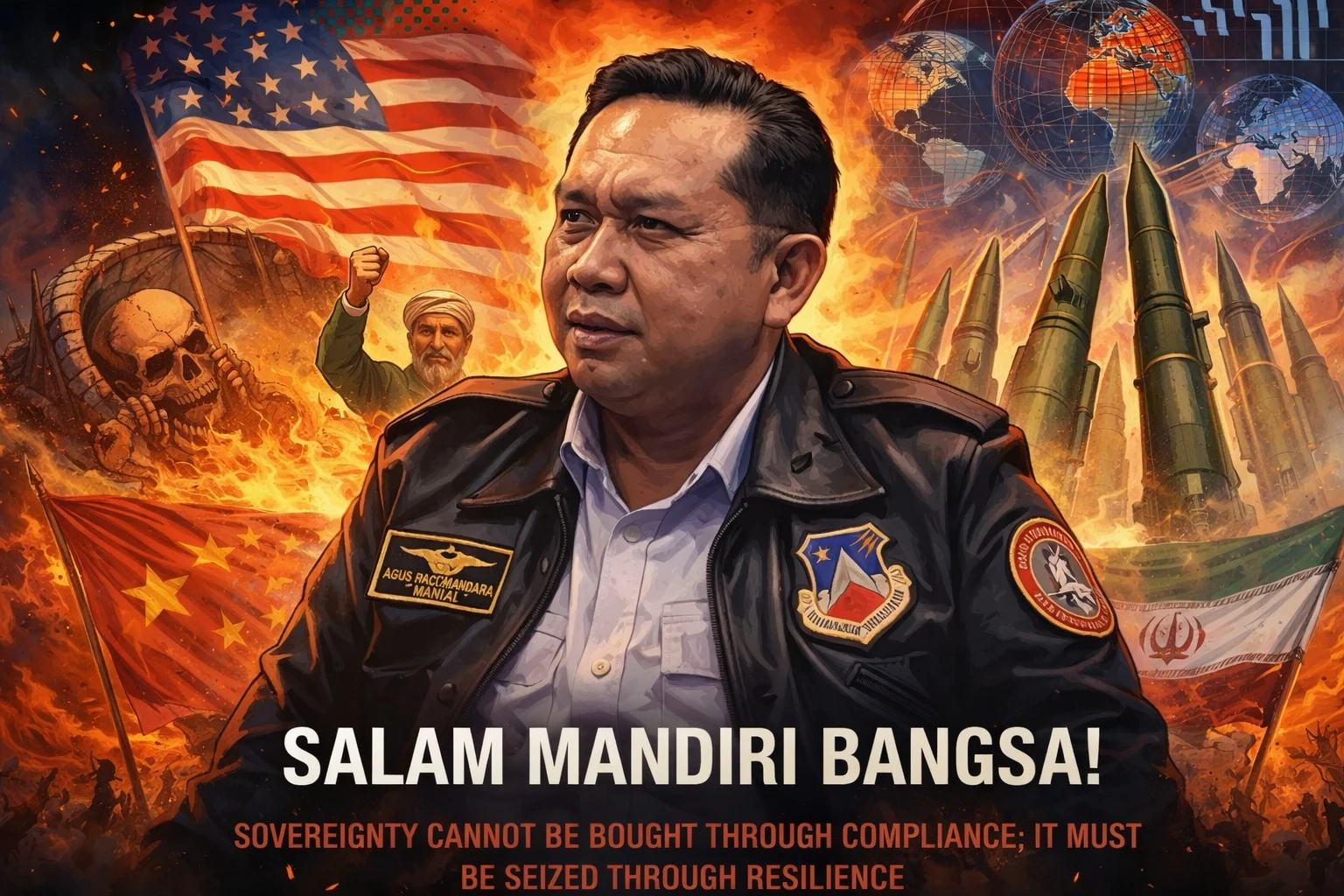
The world is witnessing a tectonic shift in the global power structure. The United States, a superpower accustomed to dictating the international stage, now appears to be digging its own grave by consistently underestimating the endurance of its adversaries. For Gerakan Mandiri Bangsa (GMB), the case of Iran serves as definitive proof that sovereignty cannot be bought through compliance; it must be seized through multi-dimensional fortitude.
The Failure of the Instruments of National Power (DIME)
In the strategic doctrines studied at elite defense institutions like the US Air War College, there are four primary Instruments of National Power (DIME): Diplomacy, Information, Military, and Economy. Iran has been brutally pressured across all four fronts for over 40 years.
Diplomatically, Iran was isolated as a “pariah state.” Informationally, global media was leveraged to construct a “rogue regime” narrative. However, as analyzed by Air Vice Marshal (Ret.) Agung Sasongkojati, a nation’s strength is not merely measured by the volume of its “glass of water” or its material sophistication. True strength lies in the Will to endure. The U.S. spent 20 years in Afghanistan only to ultimately bite the dust against the Taliban—a bitter lesson that high technology without a deep understanding of the adversary’s psychology is a recipe for strategic failure.
“Resistance Economy”: The Antithesis of Global Dependency
For four decades, economic embargoes were designed to collapse Iran from within. Theoretically, with an economic capacity throttled to 50%, the nation should have collapsed. Instead, this pressure became a crucible (kawah candradimuka) that forged a “Resistance Economy.”
Forced to innovate independently because global financial access was severed, Iran transformed into a self-reliant nation. They refused to go cap in hand to foreign powers. Supported by Multipolar forces such as Russia and China, Iran has proven that in the 21st century, a single hegemon can no longer close all doors to a nation that possesses self-respect and food/energy independence.
Air Power and Missile Strategy: The Asymmetric Edge
As an air power strategy expert, Air Vice Marshal (Ret.) Agung Sasongkojati highlights that Iran did not fall into the trap of an expensive conventional arms race to match Western air power head-to-head. Instead, they developed Tactical Ballistic Missiles and asymmetric technologies.
This move created an asymmetric deterrent that gives adversaries pause for thought before considering any aggression. Iran understands that air sovereignty does not always require matching the number of the West’s latest generation fighter squadrons, but rather creating an unbearable risk to the enemy’s bases and assets through domestic missile precision.
A Message for Indonesia: Stop Being a Follower Nation!
The lesson from Iran is a stark warning to Indonesia not to be lulled into a false sense of security under the umbrella of fragile global partnerships.
Gerakan Mandiri Bangsa asserts:
Technological Independence: We must stop being proud as mere end-users and start becoming creators of our own defense systems.
Sovereignty is Non-Negotiable: Do not fear diplomatic pressure or isolation if it is for the sake of national dignity and protecting our wealth.
The Independent Mentality: We must refuse to play second fiddle to foreign interests in our own region.
True sovereignty belongs only to those brave enough to stand on their own two feet. Iran has proven it; it is now time for Indonesia to determine its own strategic direction without the intervention of foreign lobbies.
Independence Forever! Salam Mandiri Bangsa!
Contributor Profile
Air Vice Marshal (Ret.) Agung Sasongkojati is a prominent air power strategy expert (PPAU) and an alumnus of the US Air War College. He possesses a deep understanding of Western military doctrines and how to adapt those strategies into a framework of independent, effective, and asymmetric national defense.