Though Worn and Tattered, It Is Ours: True Sovereignty from Babe Sabeni’s Old Oplet
Ever felt exhausted being a salaried employee, only to have the entire direction of your life dictated by someone else? Decades ago, Babe Sabeni answered that very anxiety right from the driver’s seat of his own ramshackle oplet.
Jakarta never truly sleeps. But it often forgets how to listen.
Amid the roar of city buses chasing quotas and glass skyscrapers reflecting the sky without ever touching it, there is a lone, sputtering voice fighting against the current: the exhaust of an old oplet. Its smoke is thick and black, billowing lazily, disrupting a cityscape obsessed with appearing flawless. To some, this oplet is a relic of the past that should have been buried long ago.
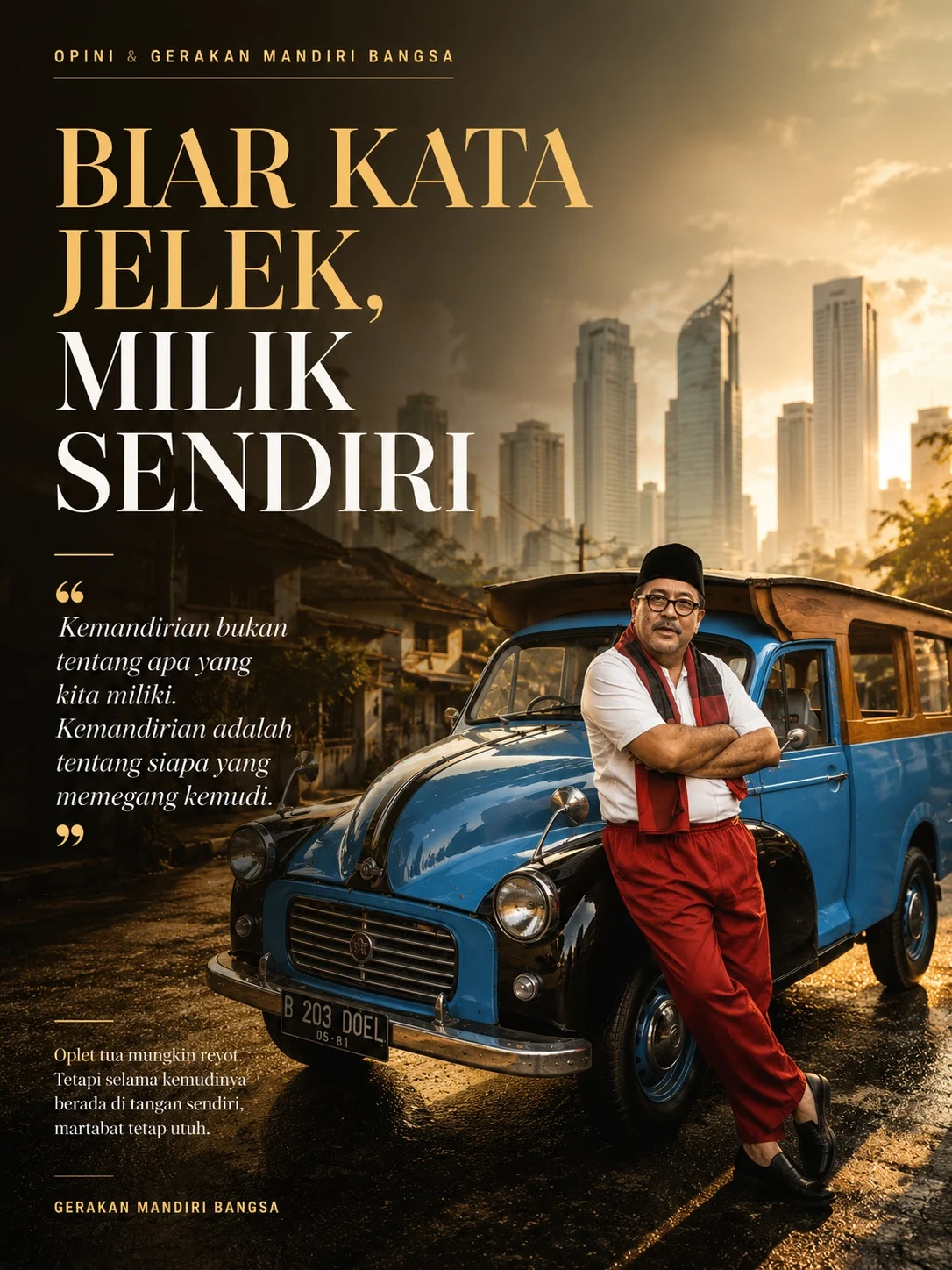
But to Sabeni—whom everyone calls Babe—that oplet is no mere heap of scrap metal. It is his modest throne of sovereignty. It is the place where a Betawi man stands tall on the merit of his own sweat, without ever having to bow to anyone. Though worn, though tattered—it belongs entirely to him.
It is from this oplet that our story begins. A story about a young man named Doel, ancestral land sold in exchange for a degree, and a persistent question this nation has never fully answered: who truly deserves to steer the development of a village, a city, or a country? Is it the everyday people sweating on the asphalt, or those sitting comfortably in air-conditioned boardrooms, far removed from the smell of the earth and the grit of labor?
The honest answer lies in a simple phrase spoken by an old oplet driver to his son: *though worn and tattered, at least it is ours.* Therein lies true self-reliance—not in borrowed luxury, but in keeping the steering wheel firmly in your own hands.
Sold Land, Risked Knowledge
There was a quiet but fierce logic behind Babe’s decision to sell acres of inherited land to fund Doel’s university education. It wasn't a mere transaction. It was a monumental gamble.
He traded something tangible—land you can stand on, inherit, and cultivate—for something completely abstract, a harvest that would take years to materialize: knowledge. The stakes were nothing less than breaking a generational cycle of poverty passed down from grandfather to father, and father to son, as if it were an inescapable destiny.
"So you won't have to suffer like me, your mother, and our ancestors before us."
This sentiment, in all its variations, is the solemn vow of millions of grassroots parents across this nation. They sell their fields, mortgage their orchards, and toil until their bones ache. It is never so their children can flaunt shiny consumer goods; it is so they have the intellectual armor to rewrite a historical destiny imposed upon them.
Yet, there is a painful irony here that is rarely spoken aloud. The very education fought for with the lifeblood of ancestral land too often traps young minds into becoming mere cogs in an industrial machine owned by the elite. Doel wasn't sent to school just to return and watch his hometown stagnate, yet he was nearly swept away by an urban current—becoming a white-collar worker, prestigious by title but utterly subjugated by structure. A diploma, which ought to be an instrument of liberation, can quietly morph into a softer, subtler chain—no longer the chain of poverty, but the chain of subordination.
This leaves us with a question that every grassroots family must ponder: what is the ultimate purpose of pursuing knowledge? Is it to return and build your own community, or is it to serve someone else's empire for a salary that slowly makes you forget where you came from?
The Thesis, the Campus, and Who Is Truly 'Uncivilized'
There is a poignant moment in Doel's internal struggle when he is dismissed as primitive and "kampungan" (backward) by Roy—the epitome of the urban elite who believes that modern clothes equate to human superiority. Doel, in all his humility, is reduced to a mere subject for a university thesis. He is not seen as an equal partner in dialogue, but as an exotic specimen to be observed, cataloged, cited, and discarded once the academic data is sufficient.
This is far from fiction. How many indigenous villages, fishing communities, and coastal settlements are visited by waves of researchers every year? Their local wisdom is documented, rituals photographed, and languages recorded. Yet, once the research paper is published and academic credentials are secured, the village returns to its quiet neglect. It remains impoverished. It remains without proper electricity. It remains a mere footnote in someone else's journal while the researcher climbs the professional ladder.
Doel’s measured response shatters this entire elitist logic: "Who among us is truly uncivilized?" This wasn't just a defensive retort; it was a profound cultural indictment. Modernity devoid of egalitarian ethics is a facade. The grassroots do not seek pity or to be treated as research specimens; they demand an authentic recognition of their dignity and equality.
The Oplet Manifesto: Independent and Untamed
Babe’s greatest fury erupted not when Doel was unemployed after graduation, but when his son—now holding an engineering degree—chose to compromise, applying to be a driver under the command of an elite corporate firm. To Babe, this was a betrayal of the very essence of independence.
"Instead of driving for someone else, you'd better drive this oplet again! Though it's old and tattered, it is ours!"
This legendary outburst wasn't born out of petty pride. It was a manifesto. Embedded within it is an economic philosophy far more mature than many developmental theories taught in university lecture halls: a rugged independence is infinitely more dignified than a borrowed luxury that bears someone else's name.
The ramshackle oplet—whose engine occasionally stalls on inclines and whose exhaust bellows black smoke—remains entirely his. Driven by him. Guided by him. It requires no orders from above to decide its next destination.
Contrast this with the position of a corporate driver. The pay might be higher, the uniform crisper. But the route, the speed, and the destination are entirely dictated by another. This is what Babe recognized as a modern form of servitude—not one forged in iron chains, but one brilliantly packaged in pay slips and neat attire, reducing a human being to an extension of someone else's will.
On a macro scale, this philosophy is the foundation of genuine sovereignty. It represents economic localization and a mental decentralization that is firmly rooted in one's own soil. A region with its own modest, grassroots cooperative is vastly more sovereign than one entirely dependent on centralized investments or foreign capital that can vanish the moment market winds shift. A village managing its own resources, even with rudimentary tools, possesses far greater dignity than one reduced to a spectator on its own land while all decisions are made in distant boardrooms.
"Run for Governor Sometime, Dul"
There is a hopeful remark from Babe that sounds almost like a jest, yet carries a radical proposition. He vehemently objects to Doel running off to chase corporate money in distant seas or the remote wilderness of Kalimantan while leaving his birthplace to grow aimlessly. *"You are a son of this soil; you ought to build this city, you ought to protect it,"* he urges.
This exact ethos drives our mission at **gerakanmandiribangsa.com**. A nation as vast, rich, and diverse as ours cannot be uniformly governed by a single command from a distant metropolitan center. True development cannot thrive by uprooting brilliant young visionaries from their origins. Instead, we must empower them to return, decipher local needs, and cultivate grassroots initiatives. Every region understands its own rhythm of growth, provided its people hold the reins of power.
When Babe casually quips, *"Run for governor sometime, Dul,"* he is dismantleing a rigid social hierarchy. He is asserting that the halls of power and the direction of national policy must not be monopolized by political dynasties or campaigns fueled by empty promises. The ordinary citizen, the child of an oplet driver, the son of a farmer, and the grassroots organizer have every right and capability to pilot the future of their own communities.
Authentic change will never descend from an ivory tower. It flows from the sweat of those who choose to stand their ground, from the exhaust of an old oplet that refuses to die, and from the organic solidarity we build together—from the bottom up, entirely self-reliant, toward a nation that is genuinely free.
So, Who Holds the Steering Wheel in Your Community?
For once, let the people be the governors of their own land. Not as a political title, but as an unyielding stance: that the developmental trajectory of any community is a fundamental right born of the grassroots—not a charitable hand-out from the heavens of authority.
Though worn, though tattered, though imperfect—at least it is ours. That is the true self-reliance Babe championed through his old oplet, and it is precisely what grassroots movements across this nation are fighting for: not just liberation from scarcity, but the absolute freedom to forge our own path, with the steering wheel firmly in our own hands.
Now, the question returns to us: do we want to remain drivers who look sharp in someone else's uniform, or do we have the courage to take the wheel of our own tattered oplet—knowing that though it is worn, we are the ones who decide where it goes?